increase in emotional reappraisal among Mentors
A healthier emotional processing strategyCREATECollective resilience
Collective resilience
against extremism.
Strengthening youth and community resilience to violent extremism in coastal Kenya. This is Global Trauma Project’s final consolidated report on the trauma-healing component of CREATE, October 2020 to March 2023.
- Organisation
- Global Trauma Project
- Programme
- CREATE
- Component
- Trauma healing under Outcome 1
- Geographic coverage
- Kwale, Kilifi, Mombasa and Lamu Counties, Kenya
- Reporting period
- October 2020 to March 2023
- Report type
- Final consolidated programme report
- Sub award number
- 91402S056
- Final submission date
- April 2023
Key findings
Measured change among Mentors.
78 Mentors and 294 Mentees consented to take part in the programme assessments.
reduction in self-reported aggressive behaviour among Mentors
From nearly daily to three or fewer times a weekreduction in trauma symptoms among Mentors
No difference in change by genderMentors meeting the threshold for clinical distress
A 43-percentage-point reductionProgramme evidence reported by GTP, not a controlled causal study. Findings among Mentees were more mixed; see section 5.
Executive summary
This final report consolidates Global Trauma Project’s implementation of the trauma-healing component of the CREATE programme from October 2020 to March 2023. Under CREATE Outcome 1, the intervention sought to reduce vulnerability to radicalisation and recruitment by strengthening the wellbeing, resilience, emotional regulation and social connection of at-risk youth in violent extremism hotspots in Kwale, Kilifi, Mombasa and Lamu Counties.
GTP adapted its Trauma-Informed Community Empowerment framework to the coastal Kenya context and integrated trauma healing with community mentorship. The delivery model strengthened local capacity through Team Leaders and Mentors, who then facilitated a 10-session community workshop series with young people. Phase 1 trained 8 Team Leaders, 60 Mentors and 12 CBO representatives. Phase 2 retained experienced Team Leaders, recruited additional Team Leaders for new hotspots, trained an additional 80 Mentors through a 10-day certification programme, translated the curriculum into Swahili, and expanded supervision, referral and individual support mechanisms.
A mixed-methods monitoring approach combined structured self-report measures, Heart Rate Variability assessments, workshop evaluations, observations, supervision records and participant feedback. A total of 78 Mentors and 294 Mentees consented to participate in the programme assessments. Findings showed particularly strong changes among Mentors: a 27% increase in emotional reappraisal, a 57% reduction in self-reported aggressive behaviour, an approximately 44% reduction in trauma symptoms, and a 43-percentage-point reduction in the proportion meeting the threshold for clinical distress, from 55% to 12%.
Among Mentees, quantitative changes were more mixed. Those meeting the assessment threshold for post-traumatic stress symptoms recorded an approximately 23% reduction in symptom endorsement. Average resting heart rate also decreased, suggesting reduced stress and a greater sense of calm. The absence of significant change in some Mentee measures points to the need for longer and more intensive support.
Qualitative evidence consistently indicated improvements in self-awareness, emotional regulation, confidence, supportive relationships, goal-setting and help-seeking. The programme also strengthened community-based providers: Mentors and Team Leaders became more confident facilitators and locally recognised sources of support. A total of 59 Mentees and 4 Mentors received additional individual support, while referrals connected participants to health, social, education, documentation and livelihood services.
The central programme lesson is that trauma healing in settings affected by violent extremism requires time, trusted local providers, continuous supervision and strong referral systems.
Future programming should run for at least 12 months, maintain gender-responsive safe spaces, include parents and caregivers, clarify the provider training pathway, strengthen professional mental health supervision, localise venues within walkable communities, and integrate harmful gender norms, youth voice, livelihoods and context monitoring.
Programme background
Global Trauma Project works to prevent and reduce the effects of trauma and adversity so that children, families and communities can thrive. In September 2020, GTP entered into a sub award with Mercy Corps to design, implement and evaluate the trauma-healing component of CREATE Outcome 1. The programme focused on young people in coastal Kenya who faced compounded stress, violence, exclusion, limited livelihood opportunities and other factors associated with vulnerability to recruitment by violent extremist groups.
The intervention was implemented in two phases. The first phase established and tested the model from October 2020 to June 2021. The second phase, implemented through March 2022, strengthened the local provider network, expanded into new hotspots, translated materials, increased supervision and incorporated learning from the first cohort.
1.1 Programme objective
The trauma-healing component aimed to increase the wellbeing and resilience of at-risk youth and strengthen their capacity to manage stress, regulate emotions, build supportive relationships, develop positive identities and pursue constructive life goals. It also aimed to equip local community providers to facilitate safe, culturally relevant healing and mentorship processes.
1.2 Geographic and partner coverage
Implementation covered selected hotspots in Kwale, Kilifi, Mombasa and Lamu Counties. GTP worked through local CBOs, Team Leaders, Mentors and other stakeholders. This layered arrangement connected technical expertise with trusted community relationships and enabled regular feedback from the field.
Programme model and methodology
2.1 Trauma-Informed Community Empowerment framework
TICE served as the foundation for training, assessment, facilitation and provider support. It is designed for communities affected by trauma, stress and adversity where formal mental health services may be limited or underused. The framework centres personal wellbeing and community care across six interconnected concepts.
Safety
Establishing predictable, respectful and confidential group environments and recognising internal and external sources of safety.
Regulation
Understanding the brain and body under stress and practising skills to manage energy, emotions and triggers.
Connection
Building trust, belonging, peer support and links to helpful people and services.
Identity
Exploring personal and social identity, parts of self, values and experiences of injustice.
Empowerment
Strengthening agency, decision-making, problem-solving, leadership and purposeful action.
Joy
Reconnecting with hope, positive emotion, future vision and post-traumatic growth.
TICE concepts and their application in CREATE.
Self-care was treated as a central principle. Team Leaders and Mentors first applied the concepts to their own wellbeing before supporting others. This emphasis recognised that community providers are also affected by the environments in which they work.
2.2 Contextualisation and curriculum adaptation
GTP combined fidelity to the six TICE concepts with flexibility in delivery. Consultation with CBOs and stakeholders informed adaptation for coastal Kenya and for issues connected to violence and violent extremism. Adaptations addressed safety, belonging, justice, economic agency, gender-based violence, low literacy, youth exclusion, limited role models, COVID-19-related livelihood loss and the need for youth-centred spaces. Stories, pictorial materials and participatory methods were used to make complex psychosocial concepts accessible. Phase 2 added a Swahili translation, with both English and Swahili copies supplied to Mentor teams.
2.3 Community workshop series
- 1
Welcome and Overview
Build rapport, establish group agreements and introduce stress, trauma and adversity.
- 2
Personal Wellbeing Assessment
Introduce reflective check-in and complete voluntary pre-assessments after initial trust building.
- 3
Introduction to Wellbeing
Understand stress, biology and trauma and connect learning to self-care.
- 4
Brain Under Stress
Explore survival and thinking brain responses and practise regulation.
- 5
Resilience
Identify risk and protective factors, strengths, coping resources and community assets.
- 6
The Fisherman, Part 1
Use metaphor and parts of self to explore identity, injustice and violence.
- 7
The Fisherman, Part 2
Develop self-compassion and understand needs, emotions and behaviour.
- 8
Changing Our Patterns
Use participatory theatre to understand and interrupt cycles of conflict and violence.
- 9
Growth and Joy
Clarify life vision, identify barriers and reconnect with joy and possibility.
- 10
Post-Assessment and Closure
Reflect on change, repeat voluntary assessments and plan continued wellbeing practices.
2.4 Training methodology
Training followed an experiential cascade model. GTP trained and supported Team Leaders, Team Leaders trained Mentors with GTP supervision, and Mentor pairs facilitated the community series. Each provider first experienced the activities as a participant, then practised delivery through teach-backs and received structured peer and trainer feedback. Methods included guided reflection, visual learning aids, storytelling, group discussion, role play, participatory theatre, regulation exercises, paired practice, case discussion and supervised field application.
Implementation and key activities
3.1 Phase 1 implementation
- Recruited and onboarded the GTP implementation team and engaged programme partners and community stakeholders.
- Identified and trained 8 Team Leaders to support Mentors and oversee delivery in programme hotspots.
- Trained 60 Mentors and engaged 12 CBO representatives in the trauma-informed change-making model.
- Facilitated the ten-session community workshop series for 267 at-risk youth.
- Held weekly capacity-strengthening, planning and wellbeing sessions for Team Leaders and Mentors.
- Provided individual support, counselling supervision, referrals and graduation activities.
- Administered voluntary pre- and post-wellbeing and HRV assessments.
3.2 Phase 2 implementation
Phase 2 retained seven experienced Team Leaders and identified two additional Team Leaders to cover Hindi in Lamu and Msambweni in Kwale. GTP delivered a six-day TICE Part 1 refresher from 18 to 23 October 2021 and a five-day TICE Part 2 refresher from 11 to 15 December 2021. Fourteen people attended the first refresher, including nine Team Leaders, four GTP staff and one Mercy Corps staff member; all nine Team Leaders attended the second refresher.
Sixty Mentors completed an eleven-day training programme comprising six days for TICE Part 1 and five days for TICE Part 2. Certification combined training attendance with facilitation of the ten-week community series. Team Leaders and GTP staff supervised teach-backs, field application and use of programme monitoring and referral tools.
3.3 Mentorship and support supervision
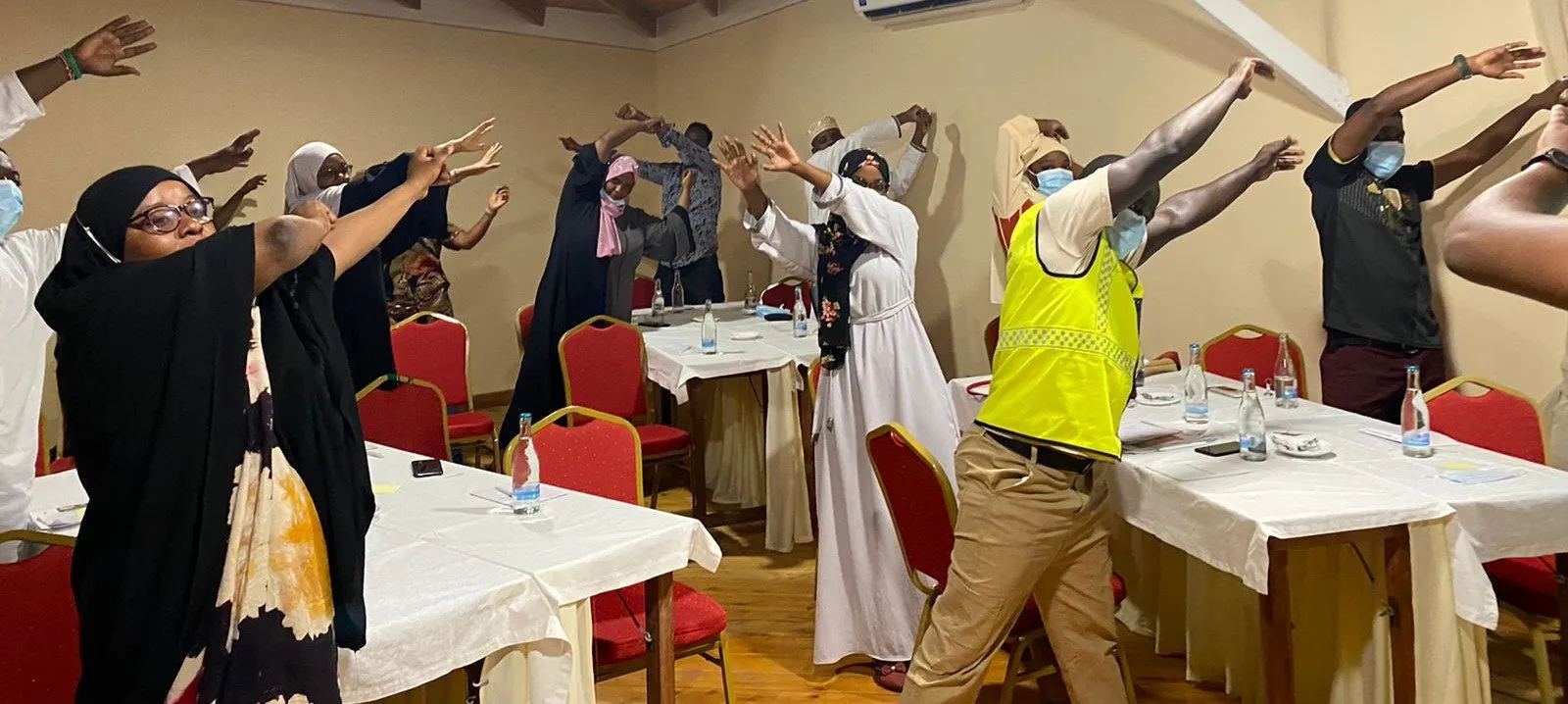
GTP held weekly capacity-strengthening sessions with the nine Team Leaders throughout Phase 2. Sessions combined personal wellbeing check-ins, technical review, planning, problem-solving and preparation for Mentor training and community workshops. GTP also held monthly Mentor debriefs, participated in stakeholder forums and completed seven physical support supervision visits in Kwale, Mombasa and Kilifi. Two remote support sessions were provided to Lamu teams when security conditions limited travel.
3.4 Individual support and referrals
Individual sessions supplemented group workshops where participants required privacy, focused support or connection to specialised services. Fifty-nine Mentees and four Mentors received additional support. Mentees comprised 17 males and 42 females across Kilifi, Lamu, Mombasa and Kwale. The sessions also supported referrals to health, social, education, identification documentation and livelihood services.
| Location or group | Male | Female | Total |
|---|---|---|---|
| Kilifi Mentees | 5 | 12 | 17 |
| Lamu Mentees | 7 | 8 | 15 |
| Mombasa Mentees | 5 | 13 | 18 |
| Kwale Mentees | 0 | 9 | 9 |
| All Mentees | 17 | 42 | 59 |
| Mentors | 2 | 2 | 4 |
3.5 Stakeholder engagement and youth voice
Stakeholder forums brought together Mentees, Mentors, caregivers, CBOs, programme partners, county representatives and education and private sector actors. In Kwale, 72 Mentees presented a memorandum identifying barriers related to education certificates, vocational fees, industrial attachment, identification documents, livelihoods and youth participation in decisions. This process demonstrated growing confidence and supported practical follow-up by local partners.
Monitoring, evaluation and learning
4.1 Evaluation design
Monitoring combined quantitative and qualitative methods. GTP and its research partner, the New School for Social Research, selected standardised self-report measures and HRV assessment. These were complemented by end-of-workshop evaluations, attendance and activity records, support supervision observations, weekly and monthly reflection sessions, and feedback from Mentors, Mentees, caregivers and stakeholders.
4.2 Assessment measures
| Measure | Construct assessed | Respondent group |
|---|---|---|
| HTQ | Trauma symptom experiences | Mentors and Mentees |
| HSCL-10 | Anxiety and depression symptoms | Mentors |
| ABS | Self-reported aggressive behaviour | Mentors and Mentees |
| ERQ-10 | Emotion regulation strategies | Mentors |
| MAIA | Awareness and interpretation of internal body signals | Mentors and Mentees |
| BRS | Perceived capacity to recover from stress | Mentors |
| HRV | Physiological indicator related to stress regulation | Mentors and Mentees |
Participation in all assessments was voluntary. Participants used codes instead of names to protect confidentiality. Seventy-eight Mentors and 294 Mentees consented and participated in the assessment measures. Results should be interpreted as programme evidence rather than as a controlled causal study.
Results and outcomes
5.1 Quantitative findings
| Result area | Key finding | Interpretation |
|---|---|---|
| Emotional reappraisal among Mentors | 27 percent significant increase | Mentors reported greater use of a healthier emotional processing strategy. |
| Aggressive behaviour among Mentors | 57 percent reduction | Reported frequency fell from nearly daily before CREATE to three or fewer times per week after CREATE. |
| Trauma symptoms among Mentors | Approximately 44 percent reduction | A significant reduction was reported, with no difference in change by gender. |
| Clinical distress among Mentors | Reduced from 55 percent to 12 percent | A 43-percentage-point reduction in those meeting the assessment threshold for overall anxiety and depression distress. |
| Trauma symptoms among Mentees meeting the PTSD threshold | Approximately 23 percent reduction in endorsement | Indicates improvement among a high-symptom subgroup, although overall Mentee findings were mixed. |
| Mentee resting heart rate | Overall reduction | Consistent with reduced stress and a greater sense of calm or safety. |
| HRV risk profile | Most participants remained in concerning or critical ranges | Shows continuing difficulty with flexible stress regulation and the need for sustained support. |
5.2 Interpretation of results
Mentors showed stronger and more consistent measured change than Mentees. This is plausible because Mentors received more intensive training, repeated practice and ongoing supervision before and during community delivery. Their improvement is also programmatically important because provider wellbeing and regulation influence the quality and safety of the support they offer.
Mentee results were more complex. Significant change was not observed in all self-report measures, and Mentees reported higher aggressive behaviour and trauma symptoms than Mentors at both assessment points. Increased comfort and trust may have improved honest reporting after the intervention. However, the findings also indicate that a ten-session series may be insufficient for young people facing chronic and compounded adversity. The lower resting heart rate and qualitative changes suggest progress, but longer follow-up and more intensive referral and individual support are warranted.
5.3 Qualitative and observable outcomes
- Improved emotional regulation, including greater awareness of triggers and increased use of calming and reflective practices.
- Stronger confidence and self-expression, with previously quiet participants taking part in discussions and public forums.
- Greater belonging and social capital through new friendships, peer support and trusted relationships with Mentors.
- Improved sense of agency, future orientation and goal-setting, including pursuit of education, employment, small enterprise and group initiatives.
- Improved attendance, time-keeping, personal responsibility and constructive participation reported by Mentors and caregivers.
- Greater help-seeking and use of referrals for health, social, education, documentation and livelihood needs.
- Knowledge sharing beyond the workshops, as Mentees discussed learning with friends, families and community members.
- Stronger standing of Mentors as trusted and recognised community resources.
5.4 Provider capacity outcomes
Team Leaders strengthened their ability to train, supervise and provide feedback to Mentors. Mentors demonstrated improved command of the curriculum and greater creativity in using local examples, pictorials, stories and participatory exercises. Regular check-ins improved provider self-awareness and normalised self-care, while field supervision allowed problems to be identified and resolved during implementation.
Cross-cutting findings
6.1 Gender and safe participation
Gender composition affected participation and disclosure. Groups with very few women did not consistently provide the conditions needed for young women to participate freely. The programme therefore identified a need for gender-responsive recruitment, same-gender Mentor matching where appropriate, and separate spaces when this improves safety and expression. Future curricula should also address harmful gender and social norms and engage men and boys in responsible, non-violent forms of masculinity.
6.2 Youth agency and socioeconomic stress
Young people consistently linked wellbeing with practical barriers such as unemployment, education costs, withheld completion certificates, lack of identification documents and limited participation in decisions. Trauma healing supported confidence and action, but sustainable outcomes require referral partnerships and integration with livelihoods, education, civic participation and protection services.
6.3 Local ownership and accessibility
The cascade model increased local ownership because Mentors were known in their communities and remained available beyond formal sessions. Swahili delivery, pictorial tools and local examples improved accessibility. Locating activities within walking distance and agreeing schedules with participants were also important for consistent attendance.
Challenges and adaptive management
| Challenge | Programme response and learning |
|---|---|
| COVID-19 restrictions and livelihood disruption | Adjusted delivery and recognised economic loss as both an implementation constraint and a source of participant stress. |
| Security restrictions in Lamu | Provided remote supervision when physical travel was not advisable. |
| Low female representation in some groups | Identified the need for gender-specific safe spaces and improved gender matching of Mentors and Mentees. |
| Distance and schedule conflicts | Recommended smaller geographic catchments, walkable venues and participant-led scheduling, including make-up sessions. |
| Complex mental health and protection needs | Used individual support, counsellor supervision and external referral where needs exceeded provider scope. |
| Uneven clarity on training roles | Recommended a defined pathway for Community Facilitators, Team Leaders and TICE Trainers. |
| Delayed transport and communication reimbursements | Raised the need for partner follow-up and clearer terms of engagement. |
| Demand for services beyond project scope | Strengthened referral and stakeholder engagement around education, livelihoods, documentation, health and social services. |
Lessons learned
01
Trusted local providers are central to scale.
The programme reached young people through Mentors who understood local language, norms and stressors. Their effectiveness depended on strong training, lived experience of the curriculum and continuing supervision.
02
Provider wellbeing is a quality requirement.
Team Leaders and Mentors require structured opportunities to regulate, reflect and obtain support. The strong measured changes among Mentors reinforce the value of investing in the people who deliver community care.
03
Behaviour change requires sufficient time.
Ten sessions can build awareness, trust and early skills, but participants experiencing chronic adversity need longer engagement, continued practice, follow-up and access to specialised support.
04
Group healing must connect to individual and referral support.
Some needs are not appropriate for group discussion or exceed Mentor capacity. Safe individual support, professional supervision and functioning referral pathways are essential.
05
Contextualisation improves engagement.
Swahili delivery, pictorials, stories, local metaphors and participatory methods made concepts easier to understand and apply.
06
Gender shapes safety and participation.
Recruitment, group composition and Mentor matching must deliberately create conditions in which young women and men can speak freely and receive appropriate support.
07
Youth priorities extend beyond psychosocial wellbeing.
Education, livelihoods, documentation, family relationships and civic participation affect stress and vulnerability. Effective programming must coordinate across these needs.
Recommendations
- Implement future trauma-healing cohorts over at least twelve months, with follow-up beyond the initial ten sessions.
- Maintain weekly or regular supervision for Team Leaders and Mentors and ensure access to individual supervision from qualified mental health professionals for complex cases.
- Define and communicate a progressive training and certification pathway for Community Facilitators, Mentors, Team Leaders and TICE Trainers.
- Strengthen referral mapping, documentation, feedback and accompaniment, including partnerships for health, protection, education, identification documents and livelihoods.
- Engage parents, caregivers and family members through adapted trauma-informed sessions while preserving participant confidentiality and safety.
- Use gender-responsive recruitment, same-gender facilitation where appropriate and separate safe spaces when required; integrate content on harmful gender norms and engagement of men and boys.
- Localise groups within walkable communities and plan venues and schedules with participants. Provide flexible make-up options for participants who enter work or training.
- Continue using accessible Swahili and English materials, visual aids and participatory methods, and develop audio-visual materials for continued learning.
- Integrate youth-led dialogue and stakeholder platforms so that participants can raise structural barriers and help shape programme decisions.
- Monitor political, security and economic changes that may increase youth vulnerability or disrupt implementation.
- Use longer-term outcome measurement and follow-up to assess whether changes are sustained and to better understand mixed findings among Mentees.
Conclusion
CREATE demonstrated that a contextualised, community-based trauma-healing model can strengthen local provider capacity and contribute to meaningful improvements in wellbeing, emotional processing, confidence, connection and help-seeking. Quantitative findings were strongest among Mentors, while qualitative evidence showed important early changes among Mentees. The mixed Mentee assessment results and continued physiological stress underline that short-term workshops cannot by themselves resolve chronic adversity.
The programme leaves a trained network of Team Leaders and Mentors, an adapted bilingual curriculum and practical learning for future violence prevention programming. Sustaining and deepening results will require longer implementation, provider care, professional supervision, gender-responsive safe spaces, family engagement and strong links to the wider services and opportunities young people need.
Acronyms and abbreviations
- ABS
- Aggressive Behavior Scale
- BRS
- Brief Resilience Scale
- CBO
- Community Based Organization
- CREATE
- Collective Resilience Against Extremism
- ERQ
- Emotion Regulation Questionnaire
- GTP
- Global Trauma Project
- HRV
- Heart Rate Variability
- HSCL-10
- Hopkins Symptoms Checklist
- HTQ
- Harvard Trauma Questionnaire
- MAIA
- Multidimensional Assessment of Interoceptive Awareness
- PFA
- Psychological First Aid
- TICE
- Trauma-Informed Community Empowerment
- TL
- Team Leader
- VE
- Violent extremism
CREATE Program Final Consolidated Report
The original report as submitted, April 2023 (PDF, 13 pages).
Healing. Empowerment. Transformation.
Build resilience where it matters most.
Talk with Global Trauma Project about community-based trauma healing, mentorship, and violence prevention programmes.